How to Choose the Right VHB Tape for Bonding Glass and Smooth Plastic Surfaces
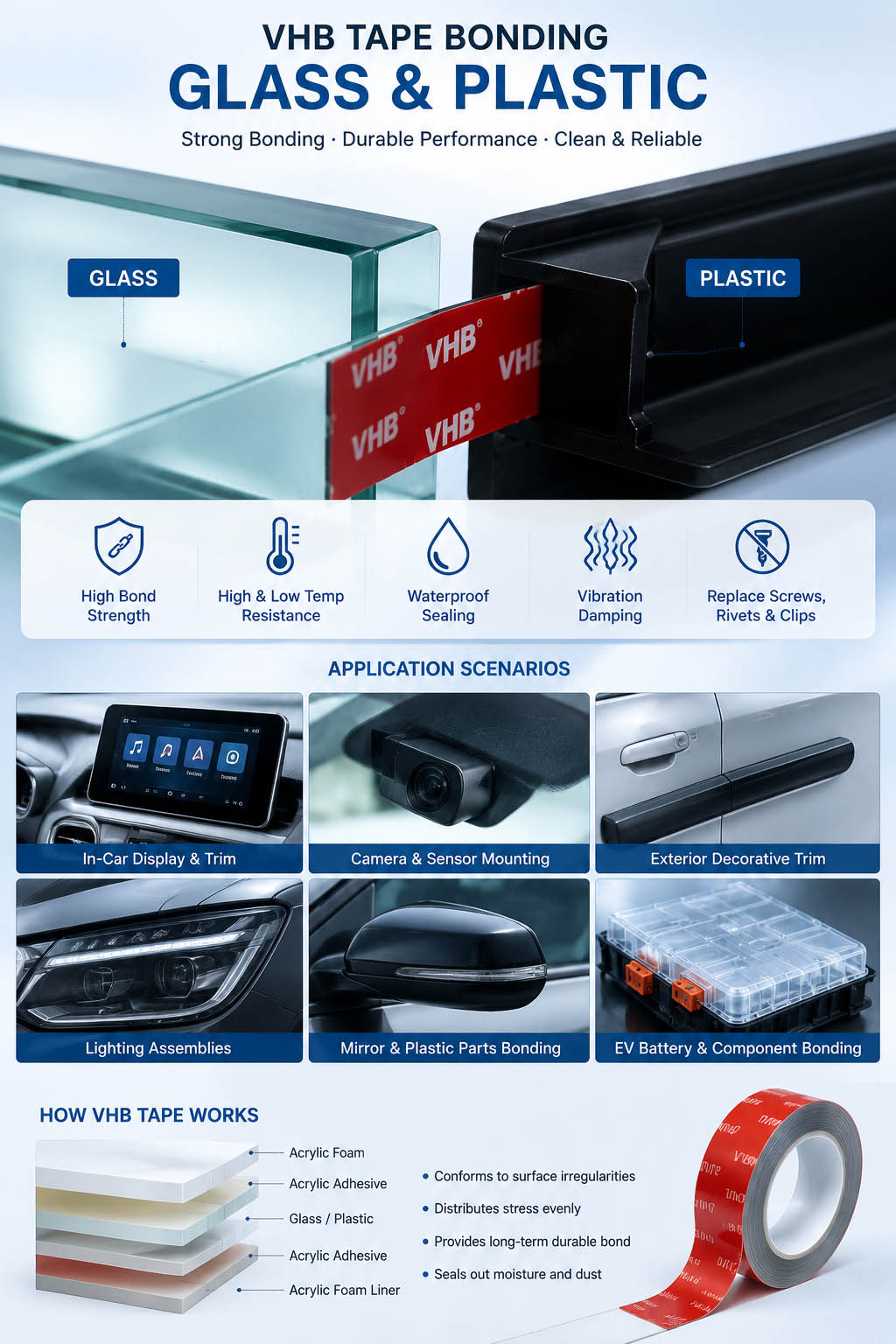
In modern industrial manufacturing, VHB (Very High Bond) acrylic foam tapes are widely used as an alternative to traditional mechanical fasteners such as screws, rivets, and liquid adhesives. They provide strong bonding performance, clean appearance, vibration damping, waterproof sealing, and long-term durability.
However, selecting the correct VHB tape for bonding glass and smooth plastic surfaces is critical to achieving reliable performance. Different materials, surface energies, environmental conditions, and application requirements all affect the final bonding result.
Understanding Surface Characteristics
Glass Surfaces
Glass is considered a high surface energy material, which means it is generally easy to bond with acrylic adhesive tapes. VHB tapes can achieve excellent adhesion and long-term durability on glass surfaces.
Common applications include:
Glass panels
Curtain walls
Electronic displays
Decorative panels
Home appliances
Plastic Surfaces
Plastic materials vary significantly in bonding difficulty.
High Surface Energy Plastics
These are relatively easy to bond:
ABS
PC (Polycarbonate)
Acrylic (PMMA)
PET
Low Surface Energy Plastics
These are more difficult to bond:
PP (Polypropylene)
PE (Polyethylene)
For low surface energy plastics, standard VHB tapes may not provide sufficient long-term adhesion. Specialized LSE (Low Surface Energy) VHB tapes are recommended.
Key Factors When Choosing VHB Tape
1. Surface Energy Compatibility
Selecting a tape compatible with the substrate material is the first priority.
For Glass + ABS / PC / Acrylic
Recommended:
General purpose acrylic foam VHB tapes
High transparency acrylic foam tapes
Features:
Strong adhesion
UV resistance
Waterproof sealing
Long-term durability
For Glass + PP / PE
Recommended:
LSE acrylic foam tapes
High initial tack VHB tapes
Features:
Excellent bonding to difficult plastics
Enhanced initial adhesion
Better long-term holding power
2. Tape Thickness Selection
Choosing the proper thickness is essential for achieving optimal bonding strength.
| Application | Recommended Thickness |
|---|---|
| Flat and smooth surfaces | 0.25mm – 0.5mm |
| Slight gaps or uneven surfaces | 0.8mm – 1.1mm |
| Structural bonding applications | 1.1mm – 2.0mm |
| Vibration damping requirements | Thicker foam tapes |
Thicker foam tapes can absorb stress and compensate for surface irregularities more effectively.
3. Environmental Conditions
Industrial bonding applications often face harsh environments. Always consider:
Temperature resistance
UV exposure
Moisture and waterproof performance
Outdoor weather resistance
Chemical resistance
For outdoor applications, UV-resistant acrylic foam tapes are highly recommended to prevent yellowing, adhesive failure, or aging over time.
4. Transparency Requirements
For visually exposed applications such as glass displays, transparent panels, or acrylic assemblies, transparent VHB tapes provide a cleaner and more professional appearance.
Common applications:
Display panels
Signage
Glass decoration
Consumer electronics
Typical Industrial Applications
Architectural Glass Bonding
Recommended:
Grey acrylic foam VHB tapes
Thickness above 1.1mm
Features:
Structural strength
Weather resistance
Long-term outdoor durability
Automotive Trim Assembly
Recommended:
High-strength grey VHB tapes
Heat-resistant acrylic foam tapes
Features:
Strong adhesion
Vibration resistance
High-temperature stability
Electronics and Display Assembly
Recommended:
Ultra-thin acrylic transfer tapes
Transparent VHB tapes
Features:
Precision bonding
Clean appearance
Excellent dimensional stability
Proper Surface Preparation
Even the best VHB tape may fail if surfaces are not properly prepared.
Before application:
Clean surfaces with isopropyl alcohol
Remove oil, dust, and moisture
Ensure surfaces are completely dry
During application:
Apply firm pressure
Allow adhesive curing time for maximum bonding strength
Most acrylic foam tapes achieve optimal adhesion after 24 to 72 hours.
Why Acrylic Foam VHB Tapes Are Preferred
Compared to screws and liquid adhesives, VHB tapes offer several advantages:
No drilling or surface damage
Uniform stress distribution
Waterproof sealing
Noise and vibration reduction
Clean and aesthetic appearance
Faster assembly process
These benefits make VHB tapes ideal for modern industrial manufacturing and lightweight product design.
Conclusion
Choosing the right VHB tape for bonding glass and smooth plastic surfaces requires careful evaluation of substrate materials, surface energy, environmental conditions, thickness requirements, and long-term performance expectations.
For high-performance industrial applications, acrylic foam VHB tapes provide an excellent combination of strong adhesion, durability, flexibility, and aesthetic appearance.
At NANOBOND, we provide advanced VHB acrylic foam tape solutions designed for glass, plastics, automotive, electronics, construction, and industrial bonding applications worldwide.